
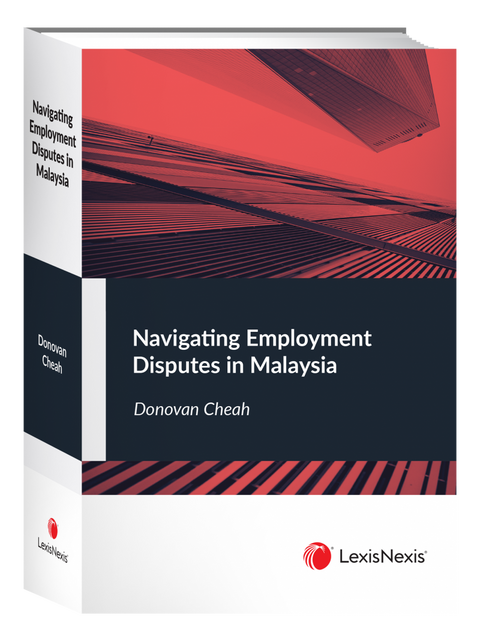


Navigating Employment Disputes in Malaysia | 2021
Select a Format
RM248.40
RM270.00 you save RM21.60
Navigating Employment Disputes in Malaysia by Donovan Cheah
| Author | Donovan Cheah |
| Publication Date | 02 October, 2021 |
| ISBN | 9789672701040 |
|
Format |
Softcover / eBook |
| Publisher | LexisNexis |
Although employment disputes are frequently limited to specific topics, they can be complex and unpredictable due to the human factor. This book is intended to assist those who, whether personally or on behalf of their firm, are faced with the onerous responsibility of resolving an employment dispute.
Features:
• Employment law simplified: Legal information is presented in straightforward, understandable English. There's no jargon.
• Current trends and new developments: The COVID-19 pandemic has altered the labour market. This book examines some of the most recent employment challenges originating from the epidemic, as well as emerging employment trends.
• Context: Useful and sensible examples are used to put key information into context.
• Practical Tips: Knowing the law is only half of the battle; the other half is putting that knowledge into practise in a commercially sound manner. Practical advice on how to handle various job issues is offered.
This resource is appropriate for business owners, human resources experts, industrial relations practitioners, and employees who wish to learn more about resolving workplace conflicts.
Features:
• Employment law simplified: Legal information is presented in straightforward, understandable English. There's no jargon.
• Current trends and new developments: The COVID-19 pandemic has altered the labour market. This book examines some of the most recent employment challenges originating from the epidemic, as well as emerging employment trends.
• Context: Useful and sensible examples are used to put key information into context.
• Practical Tips: Knowing the law is only half of the battle; the other half is putting that knowledge into practise in a commercially sound manner. Practical advice on how to handle various job issues is offered.
This resource is appropriate for business owners, human resources experts, industrial relations practitioners, and employees who wish to learn more about resolving workplace conflicts.
TABLE OF CONTENTS of Navigating Employment Disputes in Malaysia
Chapter 1: What is Employment Law?
Chapter 2: Essential Rights of Employees
Chapter 3: Common Disputes Regarding the Nature of Employment
Chapter 4: The Employment Courts
Chapter 5: Unfair Dismissal Claims in the Industrial Court
Chapter 6: Just Cause and Excuse
Chapter 7: Other Ways an Employment Can End
Chapter 8: Interlocutory Applications at the Industrial Court
Chapter 9: Enforcement of an Industrial Court Award
Chapter 10: Challenging an Industrial Court Award
Chapter 11: Inquiries before the Director General of Labour
Chapter 12: Trade Unions
Chapter 13: Civil Claims
Chapter 14: Sexual Harassment & Discrimination
Chapter 15: Dealing with Litigation
Chapter 16: Looking Forward: New Trends
Chapter 17: Concluding Remarks
MORE BOOKS ON: EMPLOYMENT LAW

Latest releases
Get your copy today!

RM120.00
CIPAA : The Debt War - A Contractor’s Fight for Payment and Life by Kamarulzaman Baharom | 2026*


Save RM45.00


Save RM45.00


On Sale from RM155.00
Child Custody in Malaysia: A Practitioner’s Comprehensive Guide by Maxine Khoo Ai Theng | 2026*
Save RM18.00


On Sale from RM910.80
Company Law: Powers and Accountability, 4th Edition by Dato’ Loh Siew Cheang (2 Vols) | 2026
Save up to RM79.20
![Law and Ethics Relating To Medical Profession [Revised Edition] By Dr. Puteri Nemie Jahn Kassim | 2026](http://www.joshualegalartgallery.com/cdn/shop/files/LibraryPoster_33.png?v=1790135039&width=480)
![Law and Ethics Relating To Medical Profession [Revised Edition] By Dr. Puteri Nemie Jahn Kassim | 2026](http://www.joshualegalartgallery.com/cdn/shop/files/LawandEthicsRelatingToMedicalProfession_RevisedEdition.jpg?v=1789451096&width=480)
RM64.00
RM67.50
Law and Ethics Relating To Medical Profession [Revised Edition] By Dr. Puteri Nemie Jahn Kassim | 2026
Save RM3.50


On Sale from RM278.20
Practical Guide to Land Law by Rajasingam Gothandapani | 2026
Save up to RM24.20


On Sale from RM206.70
Handbook on Criminal Litigation in the Magistrates’ Court by Saravanan Meyappan | 2026
Save up to RM17.95


RM351.51
RM370.00
Intellectual Property Law: Patents And Industrial Designs by A Vijayalakshmi Venugopal | 2026
Sold Out
Save RM18.49


RM332.50
RM350.00
Anti-Money Laundering Law in Malaysia by Dr Mohd Yazid Zul Kepli & Allan Suman Pillai | 2026
Save RM17.50
Malaysia's Largest Authorised Premium Reseller